
This semester, my Social Media Strategies class was broken down into nine sections. This is the first of two posts that will give an overview of what I taught in each section.
Hopefully this will serve as a reminder for the students of what they learned and as an overview for anyone else interested in what I’m teaching.
Topic 1: Performing a social media audit
It’s important to occasionally take stock of everything you are doing on social media. This will tell you some important things – including which accounts you’ve forgotten about and which accounts you’re not using to their full potential (for example: only pushing content on Twitter without interacting).
In class, we used this social media audit template to take stock of how well an individual or business was doing on social media (it’s mainly meant for an individual).
Students used the results of their personal audit to come up with a list of content they should be sharing on social networks, and to come up with five ways they could improve their own presence on social media.
More resources:
Topic 2: Native content
This topic comes from our class book, Jab, Jab, Jab, Right Hook, by Gary Vaynerchuk.
Posts that look and feel like advertising don’t work on social media. The majority of your content, even as a brand, should blend in with other content on the site.
So what is native content?
- Content that looks and feels like any other content that appears on the platform for which it was created.
- It is not cheesy, and it’s not obvious.
- It has “cool” factor.
- It hits your emotional center so hard you want to share it with someone else.
- How did we use native content?
In class, we brainstormed what kind of content we see people posting on social media platforms. For instance, here’s what we decided was native content on Instagram:
- Food
- Pets
- Family/babies
- Pictures with friends
- Landmarks/scenery
- Hashtag trends (#TBT, #MCM, etc.)
If any of these topics are in line with what your business does, that’s what you should be posting photos of on Instagram. For example, a restaurant posting photos of food would fit in very well on Instagram.
For an assignment, students came up with what they considered native content on several social platforms. We put everything together into this presentation.
Topic 3: How businesses should use Facebook and Twitter
This applies for most social networks, but we focused on the two big ones to simplify things during the semester.
Your posting strategy should include three things:
1. Native content (see above)
2. Jabs and Right Hooks
Jabs are lightweight pieces of content that benefit your followers by making them laugh, snicker, ponder, play a game, feel appreciated or escape.
Right hooks are calls to action that benefit your business.
You should mostly post jabs – enough to make your customers like you and appreciate you.
Then occasionally come with the right hook when you need something from your customers.
Here’s an example from HyVee on Twitter.
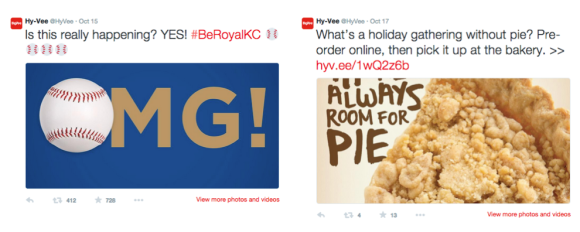
The jab on the left is just them being a fan and posting about the Royals in the World Series. The one on the right is them trying to get us to buy pies.
You can see from the favorites and retweets which one Hy-Vee’s followers liked the best. But, Hy-Vee has to sell pies. And people like to eat pies. So… give enough good jabs that make people feel good about your company, and people will be more likely to buy their pies from Hy-Vee.
3. Research on how and when to post
You can get more engagement based on the language you use in posts, the time of day you post, the length of your post, and more…
A couple links will summarize this:
Topic 4: Facebook and Twitter analytics
Twitter and Facebook both have great built-in analytics. For Twitter, go to analytics.twitter.com and for Facebook to go to the Insights tab on your Facebook page.
Both of them really focus on three things:
- How big of an audience you have (followers, likes)
- How many people you actually reach with each post
- How many people interact with each one
Your goal should be to track these things, and use better content to grow all three areas.
Students took turns running a class Facebook page and a Twitter account to test out posting strategies and to evaluate the analytics.
You can use analytics to find out more about your followers so you know what content they might be interested in (for your jabs). Since there are analytics tied to each post, you’ll know what content works and what content doesn’t work. You’ll also find the best time to reach your particular audience.
Here’s an example of what Twitter shows for each post:
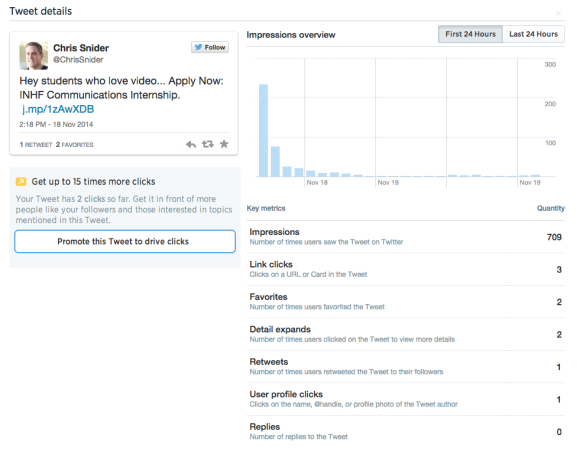
And here’s what Facebook shows for each post:

Resources:
==========