
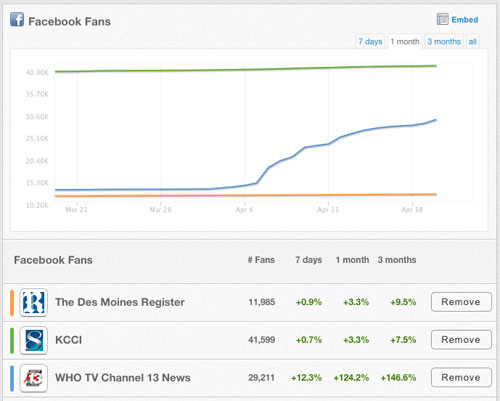
WHO-HD in Des Moines began the month of April with 13,182 likes on Facebook. That’s a respectable number, but it wouldn’t even put the station in the top half of the list of top TV stations on Facebook.
Twenty days later, the NBC affiliate is about to pass the 30,000 fan threshold (29,536 as I type this). The graph below shows the station leave the local newspaper in its dust and gain considerably on another local TV station, KCCI, leading into the May sweeps.
How did WHO do it?
The station gave away a prize each of those 20 days, including four iPad 2s. And it promoted those prizes every half hour on air.
“When we ran that (promo) during The Biggest Loser, they came flooding in,” said Tim Gardner, director of creative services for the station. “Definitely on-air drove this.”
WHO has run 20-day contests before, requiring viewers to see a special code on a newscast and enter that code online for a chance to win.
This was the first time the station ran a contest entirely through Facebook and didn’t require a special code (it’s part of a corporate initiative to grow Facebook fans across all stations, so expect to see this happening in many more markets).
Facebook has some fairly strict rules for contests, and WHO used Woobox to make sure everything was within the rules. Woobox builds in incentives for users to share a link to the contest with friends, which allows the viral nature of Facebook to take over.
A few takeaways I got talking to Gardner:
- The better/cooler the prize, the more entries you will receive. iPads were getting about 50% more entries than $250 gas cards.
- WHO’s goal was to double fans, and that goal was reached 13 days into the contest.
- The contest was a little slow to take off (in terms of entries and new likes) and it slowed down toward the end (in terms of new fans, not contest entries), so perhaps a similar effect could have been achieved in fewer than 20 days. Here’s a breakdown of how many new likes WHO gained each day, according to Wildfire Monitor:
- April 1-2: 234
April 2-3: 253
April 3-4: 344
April 4-5: 537
April 5-6: 3,600
April 6-7: 1,559
April 7-8: 890
April 8-9: 2,161
April 9-10: 432
April 10-11: 366
April 11-12: 1,599
April 12-13: 844
April 13-14: 739
April 14-15: 474
April 15-16: 310
April 16-17: 191
April 17-18: 146
April 18-19: 444
April 19-20: 906 (the final iPad giveaway)
The challenge now is to take advantage of the growing following on Facebook. Gardner said the station will be much more attentive to Facebook, with more staffers now serving as admins on the station’s Facebook page.
What’s all this worth?
By my calculations, WHO spend less than $6,000 on prizes, plus $250 for Woobox. So let’s say the station spent $6,250, plus whatever man hours went into this project.
Using this article that estimates the average Facebook fan value at $136.38, WHO gets a return of $2.2 million for that $6,250 investment. Not bad for 20 days.
Fascinating post, Chris. The way the station combined on-air promotion and Facebook is really interesting, and I didn’t know about Woobox.
I appreciate the cost breakdown at the end, and the link to the GigaOM piece. I think, though, that the value of the “like” lies entirely with what the organization hopes to do with it. What’s the overall goal? More conversation? Building community connections? More eyeballs back to the website? More eyeballs to the actual broadcast?
If I choose to like a page for a chance to win an iPad (as I’ve done repeatedly!), the owners of the page are going to have to work pretty hard to earn a spot in my regular news feed. Otherwise, I’ll unlike or hide mercilessly.
As with all engagement efforts, the key is knowing what you hope to accomplish, and what success will look like if you get there.
I think the main goal of these contests by TV stations is to get more eyeballs to the actual broadcast. That’s why we see them during or near sweeps months.
But as those Facebook fan numbers start to grow and grow, there will be other opportunities to grow TV station brands via social media.
There are plenty of people who spend hours per day on Facebook and would never think to turn on a local newscast.